Fuel Economy Calculator
Calculate your real-world fuel economy from distance and fuel used. Enter a trip distance, use two odometer readings, or combine completed fill-up intervals. See US MPG, Imperial MPG, L/100 km and km/L together, with the working behind your result.
Calculator
Inputs
Results
Enter a positive distance (or starting and ending odometer readings) and fuel used to calculate fuel economy in US MPG, Imperial MPG, L/100 km and km/L.
Unable to calculate: Correct the highlighted fields to view fuel economy results.
- Imperial (UK) MPG
- —
- Litres per 100 km (L/100 km)
- —
- Kilometres per litre (km/L)
- —
- Total distance measured
- —
- Total fuel measured
- —
Estimate based on your entered distance and fuel volume. Real-world MPG varies with speed, traffic, temperature and load.
How to Use the Fuel Economy Calculator
Choose Trip distance when you've recorded the miles or kilometers driven. Choose Odometer when you have starting and ending readings. Use Matched intervals to combine several complete distance-and-fuel records.
Enter the fuel consumed during that same driving interval, then select its unit. The calculator accepts liters, US liquid gallons and Imperial gallons. You can mix a distance unit with any supported fuel unit because the quantities are converted before calculation.
Required fields start blank. Load example fills in a labelled hypothetical record, Reset clears your required inputs, and Copy results or Print becomes available after a valid calculation. Use a decimal point without thousands separators, such as 356.2 rather than 356,2.
How to Calculate MPG From a Refill
Divide miles driven by gallons used: MPG = miles ÷ gallons. To use refill volume as a practical measure of fuel burned, start and finish at comparable full tank levels and include every fuel purchase between them.
The FuelEconomy.gov odometer method describes recording both readings and the closing refill. You don't need the tank to be empty. You need the distance and fuel to cover the same interval.
- Fill normally and record the odometer, or reset the trip meter while parked.
- Drive and retain the volume from any intermediate fuel purchases.
- At the closing comparable full refill, record the ending reading and refill volume.
- Subtract the odometer readings and add the fuel purchased after the start through the final refill.
Follow your vehicle's refueling instructions and avoid topping off past the normal automatic stop. A partial refill can remain in your record, but it normally doesn't establish the endpoint by itself. The partial-fill guide shows the full bookkeeping example.
Fuel Economy Formulas and a Worked Example
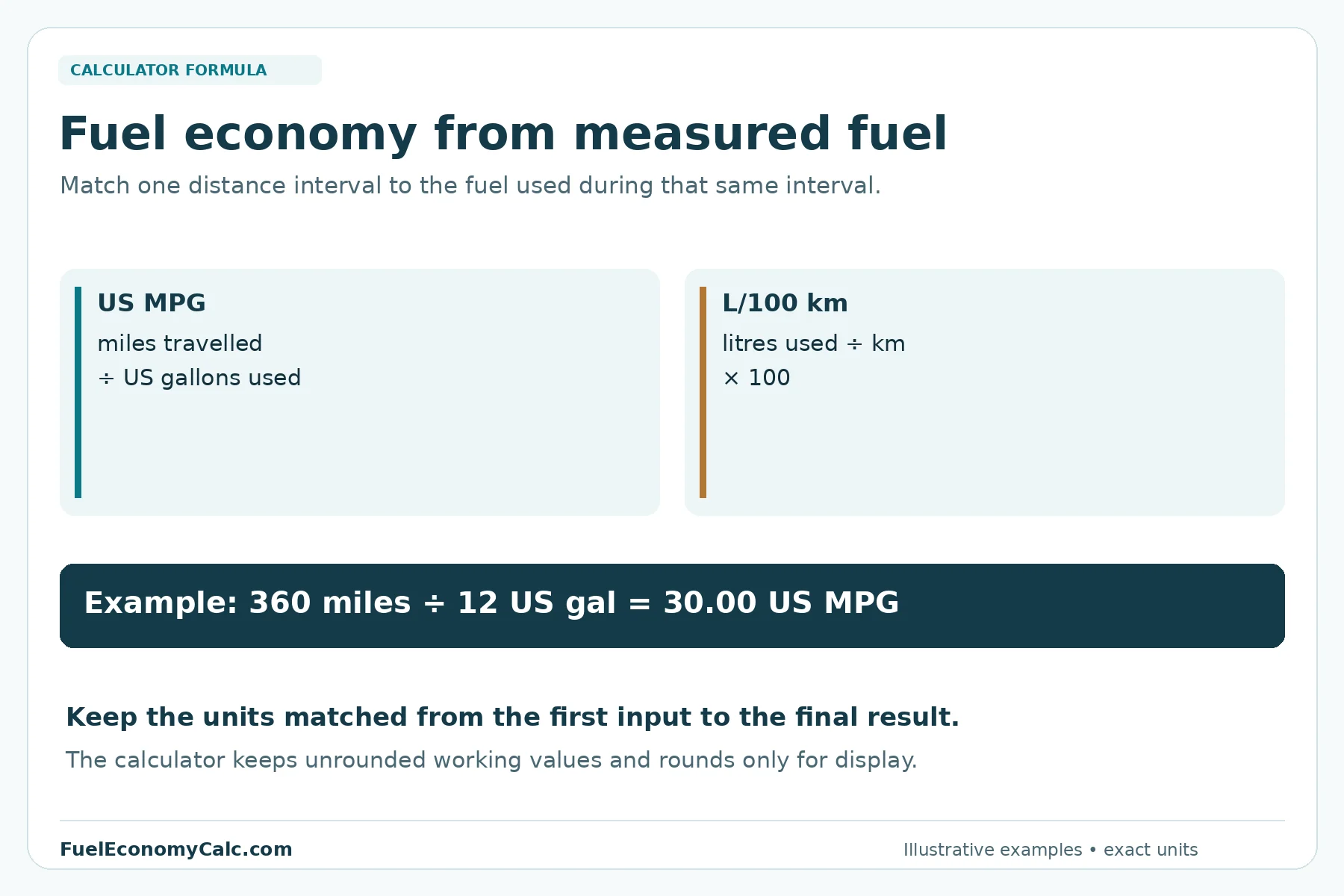
The calculator uses one physical fuel-to-distance ratio and then expresses it in four familiar units. NIST's conversion reference supplies the unit definitions. No vehicle-specific adjustment is applied.
| Output | Calculation in matching units | How to read it |
|---|---|---|
| US MPG | Miles ÷ US gallons | Higher means more miles per US gallon |
| Imperial MPG | Miles ÷ Imperial gallons | Higher means more miles per Imperial gallon |
| L/100 km | Liters ÷ kilometers × 100 | Lower means less fuel for the fixed distance |
| km/L | Kilometers ÷ liters | Higher means more kilometers per liter |
For a hypothetical 356.2 miles on 13.5 US gallons, the result is 26.39 US MPG. A separate metric example of 500 km on 40 liters gives 8.00 L/100 km and 12.50 km/L. Display rounding happens after the underlying calculation.
The graphic's US-unit example uses 360 miles ÷ 12 US gallons = 30.00 US MPG. Its metric relationship is L/100 km = liters used ÷ kilometers driven × 100.
US and Imperial MPG are not interchangeable. One US liquid gallon is exactly 3.785411784 liters, while an Imperial gallon is 4.54609 liters. The same physical economy therefore has a larger Imperial MPG number. Use the Fuel Economy Converter if you already know an efficiency figure and only want to change units.
Combine Trips Without Averaging the MPG Numbers
Add the original distances and fuel volumes, then calculate their ratio. A short interval and a much larger one should not automatically have equal weight.
For example, 220 miles on 8 US gallons plus 450 miles on 15 gallons gives 670 ÷ 23 = 29.13 US MPG. Averaging their separate 27.5 and 30 MPG figures would give 28.75 instead. The multiple-tank guide explains equal-distance and equal-fuel cases too.
Each matched-interval row must be complete and non-overlapping. This calculator combines your entered records. It doesn't store a fill-up history or infer missing purchases.
Use Your Result for the Next Fuel Question
Use a measured figure from driving similar to the journey you're planning. Traffic, weather, speed and load can change future fuel use, so this result describes the entered interval rather than promising the same MPG on every road.
The Fuel Cost Calculator estimates fuel spending, the Fuel Range Calculator works from fuel available, and the Fuel Savings Calculator compares two scenarios. Each tool answers a different question using explicit units and assumptions.
Frequently Asked Questions
Is this also an MPG calculator or gas mileage calculator?
Yes. MPG and gas mileage are common ways to express measured fuel economy. This page handles those terms in one calculator and shows metric consumption alongside both gallon definitions.
Can I use diesel or a gasoline hybrid?
Yes, for measured liquid fuel and distance. The arithmetic doesn't apply a gasoline-versus-diesel multiplier. It doesn't calculate electricity use, MPGe or the combined energy use of a plug-in vehicle.
Why is my result different from the dashboard?
Check the units and reset interval first. The dashboard estimates fuel use from vehicle data, while a refill calculation uses distance and replacement fuel. The dashboard MPG guide explains how to compare the same interval.
Does a low MPG number prove there is a fault?
No. This calculation doesn't diagnose a vehicle or grade its economy against an unsourced universal threshold. Compare complete records from similar driving and follow the owner's manual if warning lights or other symptoms appear.